


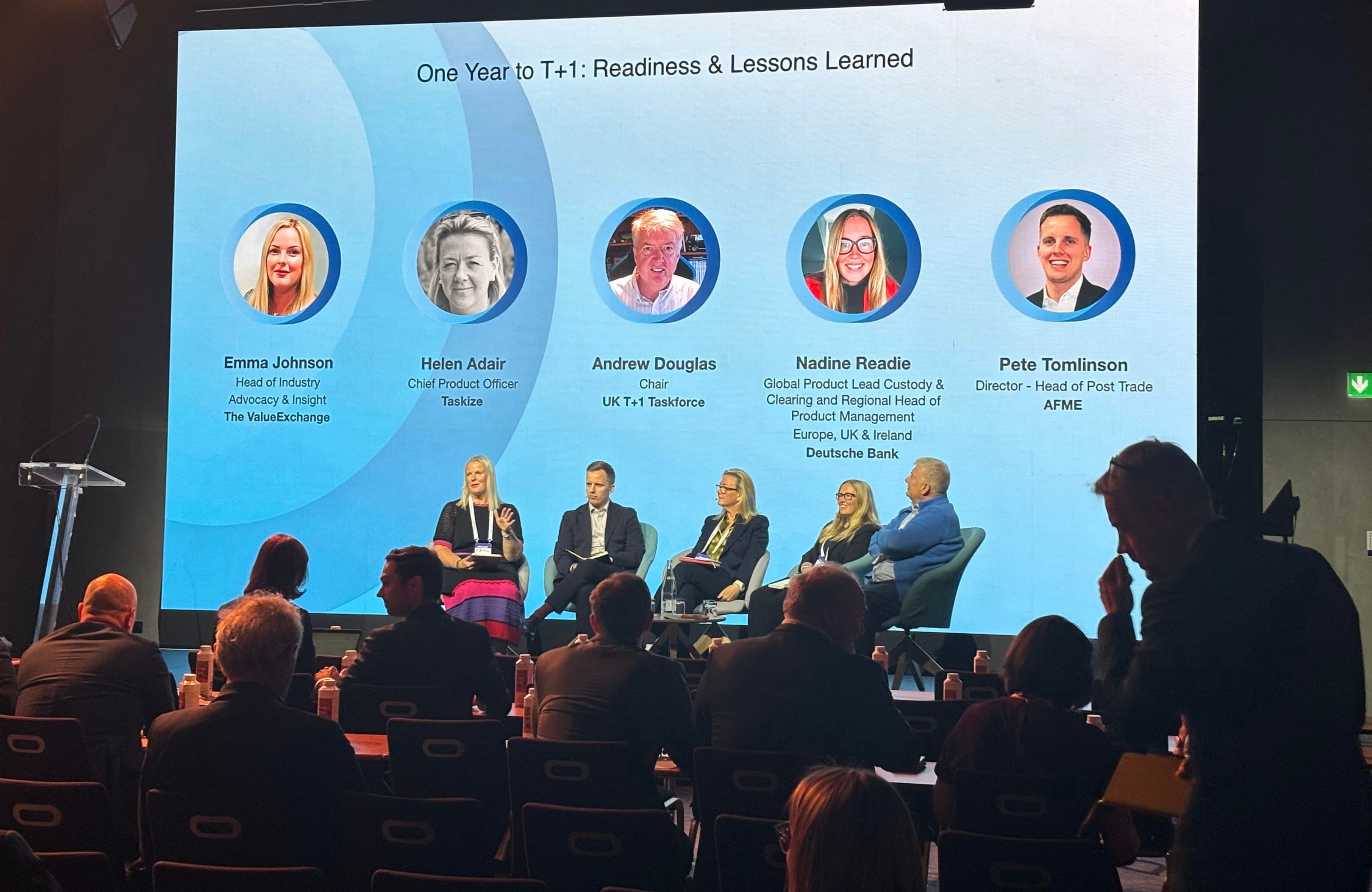
As settlement cycles shorten and digital-first strategies gain momentum, the post-trade industry is adapting quickly. Taskize speaks to some of the key players and looks at the trending issues from The Network Forum’s Annual Meeting, which took place in Paris between 8–10 June.
Read on for more, or click to jump to the views and input of...:
- AFME’s Pete Tomlinson
- Euroclear’s Isabelle Delorme
- Euroclear’s Miguel Ferreira
- Meritsoft’s Daniel Carpenter
- Societe Generale Securities Services’ Franck Bonte
- Swift’s Kelli West
- Taskize’s Helen Adair, part 1
- Taskize’s Helen Adair, part 2
- Taskize's Helen Adair, part 3
- UK T+1 Taskforce’s Andrew Douglas
1. UK T+1 Taskforce’s Andrew Douglas
The time left to prepare for T+1 compliance in Europe is shrinking as the October 11, 2027, deadline approaches.
“‘Is it too late to start preparations for T+1?’ is a question I am asked regularly at industry events,” reports Andrew Douglas.
“My answer is that it is never too late, but it soon will be. Firms responsible for late instructions or fails will incur financial penalties under T+1, but the reputational risks will be equally damaging. If organisations have high fail rates, the costs of trading with them will also be high, something which will be off-putting for counterparties. The scale of the challenge is underlined by Firebrand Research data, which found that the cost of fails and matching errors in 2025 for equities globally was US$186.1 billion.”
2. Taskize’s Helen Adair
Automation will only get financial institutions so far with T+1. A fundamental re-think of the industry’s entire operating model and behaviour needs to be considered, noted Helen Adair, Chief Product Officer at Taskize:
“Firms need to go through their front to back workflows, and identify what works and what does not. The industry needs to tear up some of these processes and acknowledge that the way we support trade flows now – versus 25-30 years ago – is no longer fit for purpose.”
Read more post-trade ops and fintech Insights from Helen Adair.
3. AFME’s Pete Tomlinson
Thorough testing and the introduction of Target2Securities (T2S) gating events are strategic priorities for the industry ahead of T+1, but progress on corporate actions seems to be stalling. To quote Pete Tomlinson, Director, Head of Post-Trade at Association for Financial Markets in Europe:
“Testing, which is being coordinated on a pan-European basis, is a key area of focus for the industry, as is the rollout of the T2S gating event. Gating events will help facilitate intraday net settlements of repo transactions, a development that should support liquidity optimisation.
“Corporate actions processing is an area where the industry needs to spend more time on, otherwise this could cause some teething issues when T+1 takes effect.”
4. Taskize's Helen Adair
“Taskize is owned by Euroclear. As a leading FMI, Euroclear has visibility into a lot of the settlement data, including fails, and the reasons for those fails. Through Euroclear’s EasyFocus+ solution, which is powered by Taskize and Meritsoft, settlement and matching data can be converted into actionable insights. The danger of not leveraging analytics during settlements is that some firms may end up creating CSDR penalty pools, and provisioning for the cost of fails through that.”
“We see a critical need to bridge traditional and digital infrastructures through connectivity, orchestration, and standards.”
5. Taskize’s Helen Adair
T+1 may have its challenges, but there are solutions available to help the industry improve its settlement discipline.
“Euroclear’s EasyFocus+ platform, developed in conjunction with Taskize and Meritsoft, provides users with vast troves of settlement data as well as where there may be issues in the settlement process. Such detailed analytics allow firms to resolve problems and reduce the risk of settlement fails. The alternative is that organisations provision for CSDR penalties.”
6. Euroclear’s Miguel Ferreira
After decades of talking about closer Financial Market Infrastructure (FMI) integration and consolidation in the EU, tangible progress does seem to be finally happening. “Europe is well positioned for further integration and consolidation of pan‑European service providers,” says Miguel Ferreira, Chief Commercial Officer, Americas & UK at Euroclear.
“This evolution supports the objectives of SIU by driving economies of scale, reducing fragmentation, and enabling the delivery of truly harmonised pan‑European services to clients.”
7. Euroclear’s Isabelle Delorme
Digital assets are slowly becoming more mainstream, but they need to deliver intrinsic value add, if they are to truly scale. As Isabelle Delorme, Head of Product Strategy and Innovation at Euroclear, reports:
“The industry has repeatedly demonstrated that it can issue, say, a digital bond, but that digital bond still has the same credit risk profile and yields as a conventional bond. For digital assets to enjoy meaningful growth, they need to do more than just deliver incremental benefits or replicate the positives of traditional markets.”
8. Swift’s Kelli West
The success of digital assets hinges on the industry getting standardisation right, a point made by Kelli West, Global Head of Securities Services and FX Strategy, Swift:
“We see a critical need to bridge traditional and digital infrastructures through connectivity, orchestration, and, most significantly, standards. We need to identify what works today and see how we can leverage that for tomorrow. Standardisation is essential to achieving security, interoperability, and resilience at scale in a tokenised ecosystem.”
9. Meritsoft’s Daniel Carpenter
T+1 is widely seen as the gateway drug to T+0, but compressing settlement cycles even further is going to be easier said than done….but not impossible.
“The interoperability required to support the implementation of T+0 is not quite there yet on a global scale. However, there is scope to introduce T+0 on an individual asset class or market basis, or even on a voluntary basis. I suspect we are 10 year or so away from T+0 becoming fully embedded across all global markets,” shared Daniel Carpenter, CEO, Meritsoft, a Cognizant company.
10. Societe Generale Securities Services’ Franck Bonte
The final word goes to Artificial Intelligence (AI), of course. A recurring topic at TNF. Although the technology is expensive, its productivity benefits are clear:
“While AI comes with real usage costs that our industry must take into account, it also has the potential to significantly enhance productivity and free up headspace for people to focus on what truly drives human value,” a point stressed by Franck Bonte, Co-Head of Transformation & Technology Delivery at Societe Generale Securities Services.
TNF Takeaways 2026, Part 1 — Getting your house in order ahead of T+1
"EasyFocus+" — TD joins early adopter programme
No Comments Yet
Let us know what you think